

State Audit Finds TEA Overstaffed with Managers
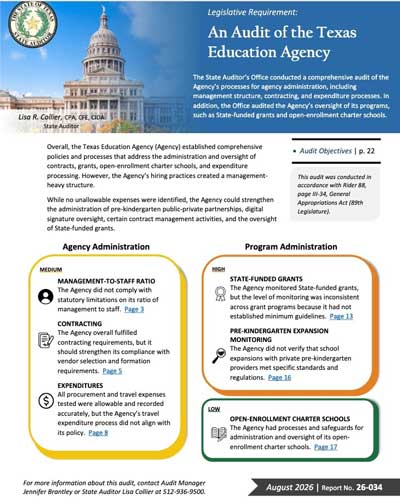
A State Auditor’s Office audit released this week gave the TEA the equivalent of a less-than-perfect score.
On the plus side, the audit concluded that the TEA generally has strong policies and processes for administering contracts, grants, charter schools, and expenditures — and auditors found no unallowable spending.
However, the audit identified several areas — classified as “risk” areas of varying degrees of concern — as needing improvement.
TEA’s Hiring Practices
Most notably, the audit says that TEA’s hiring practices have created a management-heavy organization that exceeds the state’s statutory management-to-staff ratio.
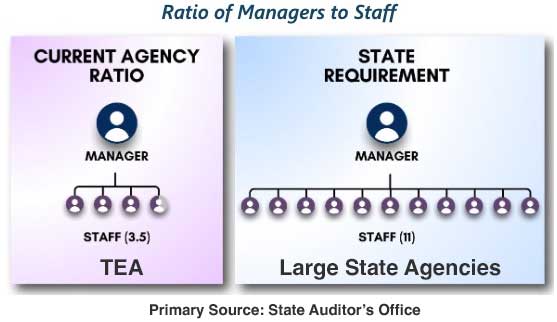
According to the report, the TEA had 1 manager for every 3.5 full-time-equivalent (FTE) employees as of August 2025 — far above the state-law minimum of 1 manager/11 FTE staff required for large state agencies (see graphic below), and well under the statewide average of 1 manager to 9.7 FTE staff.
The audit report classifies this area of concern as being of “medium risk”.
Appealed to the LBB
The TEA responded that it appealed to the Legislative Budget Board (LBB) in an effort to avoid having to restructure, arguing that many of the agency’s managers also do hands-on program work to ensure both effective team management and positive outcomes. (The result of the TEA’s appeal to the LBB is not included in the audit report.)
- Note: TEA payroll for the 2025 fiscal year (ending Aug. 31, 2025) totaled $44.7 million.
Other Areas of Concern
Other areas of concern highlighted in the report, with varying degrees of severity, included:
- State-funded grant oversight needs strengthening (High Risk) — Although TEA distributed grant funds on time, auditors found inconsistent monitoring because the agency had not established minimum monitoring standards applicable across all grant programs.
The auditors also uncovered instances where digital signatures of staff were executed on grant documents after the date that the employee had left the agency.
This created the risk that some grants may not have been adequately evaluated to ensure funds achieved their intended purposes.
- Prekindergarten partnership oversight needs improvement (High Risk) — TEA did not verify that charter schools partnering with private prekindergarten providers ensured those providers met all state licensing, accreditation, class size, and contractual requirements. Auditors said stronger oversight is needed to help ensure program quality and compliance.
- Note: The TEA responded by citing a provision tucked into 2025’s HB2 that the agency says will help solve this problem because, starting with SY 2026-27, so-called “intermediaries” will execute the PK partnership compliance review process.
- Contracting is largely compliant, but transparency can improve (Medium Risk) — TEA generally followed state contracting requirements, but some employees failed to complete required nepotism disclosure forms before contract awards, and the agency did not consistently post all required contract information online. Auditors found no unsupported contractor payments or double billing.
- Expenditures were appropriate — Although procurement card and travel expenditures reviewed were allowable, properly documented, and accurately recorded, the TEA’s actual travel approval practices did not match its written travel policy, which should be updated.
- Charter school oversight was effective (Low Risk) — Auditors concluded TEA appropriately administered new charter applications, renewals, expansions, closures, and oversight of open-enrollment charter schools.
The TEA Agreed
Overall, the report says the TEA agreed with every audit finding and committed to implementing corrective actions, including seeking approval for its staffing ratio, strengthening grant monitoring standards, improving procurement documentation, updating travel policies, retiring inactive digital signatures, and enhancing the oversight of prekindergarten partnerships.